

John G. Wanton (1729-1797) was a prosperous merchant from a powerful family in colonial Rhode Island. Son of one governor and cousin to another, John pursued a mercantile career and built a thriving business supplying the British military in North America. Wanton’s naval contracts proved especially lucrative during the Seven Years’ – or French and Indian – War (1754-1763), and allowed John to support his growing family in increasing luxury. In 1760 he married Mary Bull, the daughter of another Rhode Island governor, and over the course of the next decade the couple had two children – Mary “Polly” Wanton (b. 1763) and Gideon Wanton (b. 1766). One of the colony’s most prominent citizens between 1760 and 1775, John helped incorporate the College of Rhode Island (modern-day Brown University), became a member of Newport’s marine society, and moved his family into a large home on Broad Street, in the center of town.
Although he would later declare as a Patriot, John G. Wanton did not initially take a side in the imperial debate. As a business-owner who relied on British officials for his livelihood, he could not afford to openly defy the Empire. Still, he must have followed the news with rapt attention, and other members of the sprawling Wanton family did engage in the contest – many on the side of King George III. John’s second cousin, Col. Joseph Wanton, Jr., emerged during the 1760s as one of the leaders of Newport’s Tories, authoring anonymous essays in the local newspaper and encouraging the publication of longer pamphlets supporting British policies.

Image of the Wanton-Lyman-Hazard House on Broadway in Newport owned by John G. Wanton. Photo by Shannon Hammond Photography.
In fact, it was one of these pamphlets that allowed John G. Wanton and his family to move into their opulent new house. The house previously belonged to the lawyer and politician Martin Howard, who in 1765 had authored a widely-published essay – “Letter from a Gentleman in Halifax to his Friend in Rhode Island” – in defense of the Stamp Act. The essay sparked so much outrage that looters attacked his home during the Stamp Act riot that took place in Newport over the summer of 1765, forcing Howard and his family to flee Newport and leave their stately house. John G. Wanton purchased Howard’s abandoned property at auction, refurbished it with profits from his mercantile firm, and in 1772 moved with his young family into a home that would house three more generations of his descendants.
As news of war arrived in Newport in 1775, John G. Wanton avoided taking any strong positions. While his business accounted for some of this caution, his religion also prevented him from taking part in the conflict. Members of the Society of Friends – commonly known as Quakers, believed that killing a human being for any reason was an unforgivable sin, and thus engaging in warfare – however justified – was forbidden. Under the tenets of the faith founded by the English clergyman George Fox in the middle of the 17th century, Quakers also eschewed oaths to any power but the divine – meaning they could not formally swear loyalty to one side or the other. This taboo brought Quakers in the colonies under suspicion by both Patriot and Loyalist factions. In 1777, Congress even exiled several prominent Philadelphia Friends to Winchester, Virginia, for fear that they would aid the British army as it maneuvered in southeastern Pennsylvania. While Rhode Island’s government did not go so far, several members of Newport’s Quaker community appeared on lists of suspected enemies of the revolutionary movement, and the congregation remained under suspicion throughout the war.

Manumission Record of Cardardo Wanton from John G. Wanton. Friends Records, Vol. 821, p.13. Collections of the Newport Historical Society.
Although their faith forbade them from engaging in violence, the ideas that accompanied the coming of the American Revolution moved Quakers across the British Empire to condemn the institution of slavery as inhumane, unequal, and an insult to God. In the 1770s, the leaders of Newport’s Friends community began urging – then requiring – members to cease any engagement in the slave trade and divest themselves of their human property. The congregation’s elders threatened to expel John G. Wanton three times before he manumitted – or legally freed – an enslaved person he owned named Cardardo. Once freed, Cardardo enlisted as a free man in the revolutionary militia, where he served alongside hundreds of other men of African descent. Cardardo was discharged in October of 1777, no further references to Cardardo in the historical record have been recovered.
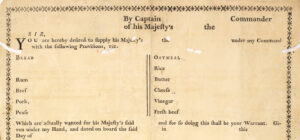
Form of provisions to outfit the British fleet, undated. FIC-2025-003. Collections of the Newport Historical Society.
The blockade of Newport Harbor put John G. Wanton in an awkward position. His business depended in large part upon the sale of food, water, and other necessities to Royal Navy vessels, even as that same Royal Navy’s cannons threatened to wipe Newport off the map over the second half of 1775. Just as he had abided by the boycott movements of the 1760s and 1770s without openly joining the Patriot faction, Wanton deferred to the rebel leaders during the blockade as well. Even after Commodore Wallace demanded that Newport merchants resupply his warships or face a devastating cannonade, Wanton still consulted revolutionary authorities before commencing the trade, attempting to stay out of trouble on both sides. Even after receiving permission to resume his provisioning business, Wanton and other Newport merchants suffered losses as the blockade stifled the import and export trade that fueled the town’s pre-war prosperity.
While John G. Wanton strove to appear neutral, newly-freed Cardardo may have fought in some of the Revolutionary War’s earliest battles. Cardardo’s name appears in at least one Massachusetts state militia muster from the town of Taunton, alongside others formerly enslaved by the Wanton family at large. Records do not indicate whether he saw combat, but coastal militia units saw almost constant action responding to naval raids along the New England coastline in 1775 and 1776, making it quite likely that while John Wanton was feeding the British Navy, Cardardo was fighting them.
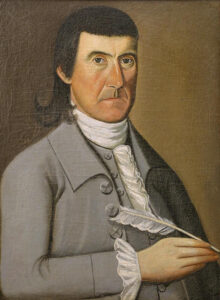
Nicholas Cooke (1717-1782), artist unknown, c.1775. Brown University Portrait Collection, BP.152.
The events of 1775 permanently divided the Wanton family. John G. Wanton’s second cousin, Joseph Wanton, Sr., was re-elected in 1775 to his sixth term as governor of Rhode Island, but refused to go along with the raising of troops to oppose the crown. As a result, the Patriot-dominated Assembly repudiated his election and replaced him with Patriot leader Nicholas Cooke, ushering in revolutionary rule in Rhode Island. While Governor Wanton and his son, Joseph, Jr., became leading Loyalists, however, John G. Wanton’s family declared for the Patriots. After fleeing the city in 1776, John even signed an oath of loyalty to the revolutionary government, finally declaring himself a Patriot.
John G. Wanton’s decision to swear an oath of loyalty to the revolutionary state of Rhode Island drew censure from the town’s Society of Friends, and he was ultimately expelled from the Society for the transgression. Although many Quakers had Patriot sympathies, most remained neutral and refused to directly support either side. Even still, Newport’s Quakers contributed to both sides during the war: in 1775 and 1776 the Continental Army drafted Quakers to help fortify the island against attack, and the British did likewise in 1777 and 1778. During the British and French occupations, Newport’s Great Friends’ Meeting House – one of North America’s oldest remaining Quaker houses of worship – served as a hospital for Britain’s German mercenaries from 1776 through 1779, then as a barracks for the French Army in 1780 and 1781 before finally being returned to the congregation in disrepair.