

This is a guest blog post by Erika Herman, a recent graduate of New York University, where she earned a master’s degree in museum studies. Erika was a 2025 Buchanan Burnham Fellow.

Christmas card with illustrations of cats published by Raphael Tuck & Sons, Artistic Series 107, FIC.2025.460, Newport Historical Society collection.
For many families, the arrival of a steady stream of Christmas cards marks the beginning of the holiday season. Some feature glossy pictures of children and pets, some are homemade with bubble letters and stickers, and others are purchased—either hastily or with thought and care—at a grocery store or pharmacy. Smiling Santas, holly wreaths and candles, or snowy scenery often grace front cover. Inside, or on the back, are well-wishes and updates from family and friends (or perhaps a bank or other corporate company). For many, sending and receiving Christmas cards is just one of many holiday traditions enacted each year.
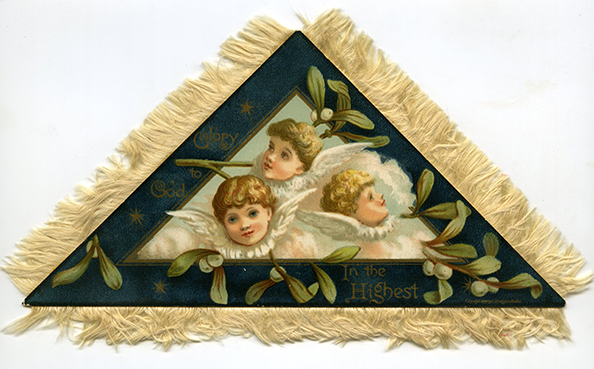
Christmas card published by L. Prang & Co., 1884, FIC.2025.598, Newport Historical Society collection.
Prior to the 1840s, Christmas cards were not a standard fixture of the Christmas season in the United States.[1] The early Puritan colonists banned Christmas celebrations, even implementing a fine for those who did.[2] Eventually celebrations of Christmas came back into fashion, especially on the East Coast, although Christmas was not declared a federal holiday until 1870.[3] The first commercial Christmas card is widely considered to have been created in England by artist John Callcott Horsley at the request of Henry Cole in 1843.[4] Like today, early Christmas cards were “primarily sentimental and social object[s]” that were used to “express friendship, remembrance, good wishes or thanks.”[5]
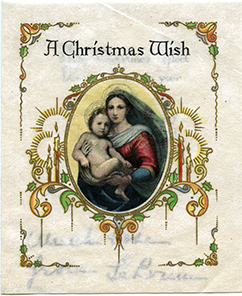
Christmas card published by Hall Brothers U.S.A, Hallmark Cards, FIC.2025.532, Newport Historical Society collection.
Many early English Christmas cards (which Americans heavily imported and used as a design model) were decorated with flowers, lace, leaves and birds—imagery that was not the most “appropriate to Christmas or winter.”[6]
Pretty, colorful illustrations that caught the viewer’s eye were more important.[7] The production of these cards operated at the intersection of the Aesthetic Movement and Industrialization. While many Christmas cards fit the ideals of the Aesthetic Movement in bringing “beauty to the masses” by creating high-quality chromolithographic prints, they were also mass produced using the newest forms of printing technology.[8] This tension between ideas of ‘true’ art and commercialized art impacted how some people viewed Christmas cards as an object. Although early Christmas cards were often beautifully crafted with detailed illustrations, the small size, mass production, and association with women (many card designers were women and women were the main senders/receivers) “kept the aesthetic card firmly in the category of decorative rather than fine art.”[9] After the 1860s, Christmas cards were seen more and more as products of industrialization and commercialization—soon lower printing costs led to lower purchasing prices and with design variation and mass production, sending and receiving cards became a Christmas tradition.[10]
Louis Prang, the “Father of the American Christmas Card”

Christmas card published in Italy by E. Sborgi, FIC.2025.417, Newport Historical Society collection.
Louis Prang (1824-1909), a Prussian born lithographer, wood engraver, and publisher, is often considered the “father of the American Christmas Card.” Prang moved to Boston in 1850 after studing wood and metal engraving, calico dying, and printing across Europe (as well as getting involved in some anti-Prussian government revolutionary activity).[11] In 1851 he worked for Frank Leslie, art director of Gleason’s Magazine, making wood engraving illustrations for the publication.[12] By 1856, he had left Leslie’s employment and partnered with Julius Mayer to form Prang and Mayer, lithographic and copper plate manufacturers.[13] When Mayer left the company in 1860, Prang became sole owner and changed the name to L. Prang & Co.[14]
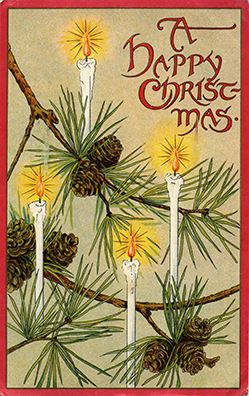
Christmas postcard published by Ernest Nister, London and printed in Bavaria, sent to Miss A. R. Almy from Bessie in 1913, FIC.2025.724, Newport Historical Society collection.
We cannot discuss Prang’s Christmas cards without discussing the printing process of chromolithography. Lithography was invented in 1796 in Germany—illustrations were made with a wax crayon on limestone treated with chemicals that would bond the wax to the stone. [15] The stone could be inked many times to produced numerous prints, as the raised illustration would not flatten over time, nor could it be washed away by water.[16] This led to lithography overtaking other printing methods in popularity for printers looking for consistent quality in, and large quantities of, their prints.[17] In 1864, Prang traveled to Germany to study printing techniques and when he returned to Boston he introduced chromolithography to his workshop.[18] Chromolithography uses the same techniques as lithography, only there are multiple stones to ink multiple colors. Previously, lithographers had printed black and white images and hand colored them.[19] Prang realized with the chromolithography process he was able to create prints that mimicked oil paintings, at a much lower cost.[20] Prang saw his use of chromolithography as a way to democratize access to art—now anyone could purchase a reproduction of a classic work of art to decorate their home.[21] However, many art critics of the time saw chromolithographic prints as “[blurring] the lines between art and commerce” which was destroying the sanctity of art.[22] Dismissed by the established art world, Prang sent prints to many leading intellectuals—including Lydia Maria Child, Harriet Beecher Stowe, Willam Dean Howells, Ralph Waldo Emerson, and Frederick Douglas—seeking endorsements about “the value of these prints for decorating the home and improving the tastes of the masses.”[23]
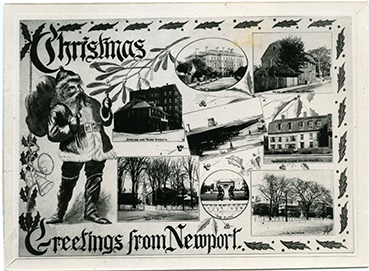
Christmas card with images of Santa and Newport landmarks, FIC.2025.510, Newport Historical Society collection.
Louis Prang introduced Christmas cards to the American market in 1874 and they became a huge success.[24] In the early 1880s, Prang held Christmas card design competitions with cash prizes.[25] Judges included John La Farge, Samuel Colman, Stanford White, and Louis Comfort Tiffany.[26] Winning artists included Dora Wheeler, Rosina Emmet, Alice Morse, Florence Taber, Elihu Vedder, Thomas Moran, J. Alden Weir, Walter Satterlee, Will Low, and Harry Beard.[27] Prang also sponsored an essay writing contest in which the competitors wrote about the social and artistic influence of the Christmas card, the proper design elements, and how Prang’s cards showcased these elements.[28] Janet Huntington McKelvey’s essay, “The Christmas Card,” also addressed the question “how could the image, mass-produced as a commodity for sale, retain aesthetic value?” a query Prang was very interested in.[29] At the time, Christmas was considered a “feminine sphere of action,” and most of the permanent design staff at Prang’s Boston studio were women.[30] Prang continued printing Christmas cards until the early 1890s when cheaper German postcards began to flood the American market.[31] In 1897, L. Prang & Company merged with the Taber Art Company of New Bedford, MA., creating the Taber-Prang Company.[32]
Change At the Turn of the Century

Handmade Christmas card, FIC.2025.647, Newport Historical Society collection.
In the 1890s, there was a decline in American and English made Christmas cards, especially with Prang’s retirement in 1899.[33] People began exchanging “gimcracks, doodads, and geegaws”—cheap, small gifts of poor quality—instead of ornate, detailed, and lavish cards like Prang’s.[34] (After 1910, Christmas cards came back in favor as they were “both more personal and practical” to send to family, friends, and acquaintances).[35] In 1895, there was a decline in greeting card production in the United States and England as European printers could produce cheaper products.[36] Almost all greeting cards were produced in Germany in the early 1900s.[37] At the same time, lower postal rates and improved delivery service made postcard popularity soar.[38] Christmas cards were no longer just for the well to-do, but for anyone who wished to send along a holiday greeting. Images on postcards sold for Christmas started becoming more “Christmas-y” than the earlier Christmas cards. Images of Santa, toys, Christmas trees, snow covered churches and houses, bells, holly, and poinsettias were popular.[39] However, “Christmas-y” did not necessarily mean more religious, and secular themes and imagery were more popular.[40] Christmas cards reflected the overall trend of commercialization of the holiday—cards depicting new technology like airplanes, cars, and telephones were also fashionable.[41] Karal Ann Marling writes in her book Merry Christmas!: Celebrating America’s Greatest Holiday, “The American card excluded acts of Christmas charity. Instead, it betrayed an avidly mercantile character, in keeping with the growing shopping component of the holiday in the United States.”[42]
World Wars and the Later 20th Century
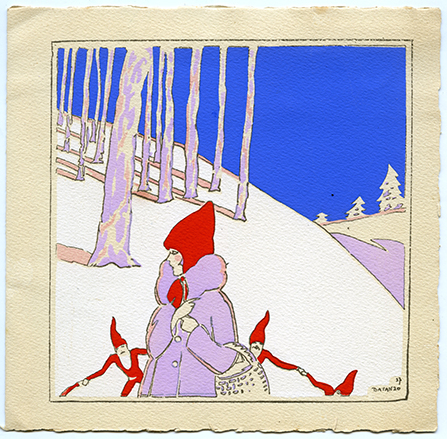
Illustrated Christmas card made in France, sent by S/SGT. Howard S. Wilson to Miss Emily Warren using U.S. Army Postal Service, 1945, FIC.2025.642, Newport Historical Society collection.
Between 1900-1910, most of the major American greeting card firms were established, including Hallmark, A.M. Davis Company, Rust Craft Greetings, American Greetings, and The P.F. Volland Company.[43] WWI impacted the Christmas postcard business by suspending importation of cards from abroad—most were made by German lithographers who created the prints for an American market.[44] With the decline of postcards, the folded card with an image and/or short text on the outside and a longer pre-written or blank space inside gained popularity.[45] The National Association of Greeting Card Manufacturers formed in 1913 and in 1918 they launched a campaign to encourage Americans to buy more greeting cards—regardless of brand.[46] After the stock market crash in 1929, and following economic depression, there was a “do-it-yourself movement” in card making.[47] Homemade cards were printed using linoleum blocks on which a message or illustration was carved, inked, and pressed onto paper.[48] In the 1940s, patriotic Christmas cards flew off the shelves and the greeting card business boomed during WWII as families sent cards to keep in touch with soldiers abroad.[49] Sending Christmas continued gaining popularity—in the 1950s an average family mailed out 100 cards during the season and in the early 2000s Americans sent around 2.9 billion Christmas cards each year.[50] Today, the number of paper Christmas cards sent have started to decline as online e-cards, email, texting, and social media have become alternatives.[51] The tradition of sending along a holiday greeting to friends and family continues—even if in a new form. From the Horsley-Cole card to e-cards, the design of Christmas cards has gone through many changes. Yet the purpose and sentiments remain the same—to wish one another well at the end of the year and happiness in the next.
For more Christmas cards, look at the Newport Historical Society’s Collection of Holiday and Greeting Cards, 1840 – 1991
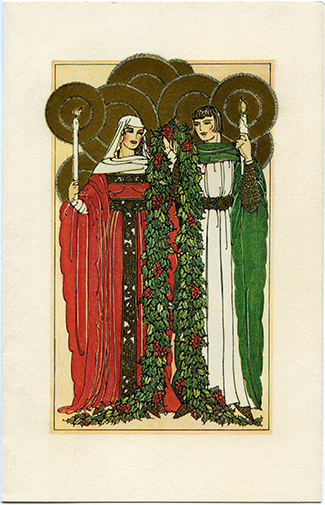
Christmas card sent by Mr. and Mrs. John A. Roebling, FIC.2025.775, Newport Historical Society collection.
[1] Karal Ann Marling, Merry Christmas!: Celebrating America’s Greatest Holiday (Harvard University Press, 2000), 288, http://ebookcentral.proquest.com/lib/nyulibrary-ebooks/detail.action?docID=3300577.
[2] Nissenbaum, The Battle for Christmas, 4-5.
[3] Philip Hancock, Organizing Christmas (Routledge, 2023), 39, https://doi-org.proxy.library.nyu.edu/10.4324/9781315637969 and Andy Thomas, Christmas: A Short History from Solstice to Santa (Ivy Press, 2019), 25, http://proxy.library.nyu.edu/login?url=https://search.ebscohost.com/login.aspx?direct=true&db=nlebk&AN=2323225&site=ehost-live&ebv=EB&ppid=pp_Cover_1
[4] “The First Christmas Card,” The Victoria & Albert Museum, accessed August 7, 2025, https://www.vam.ac.uk/articles/the-first-christmas-card?srsltid=AfmBOorWtAVj3k5oLjODlCu8Y6dDV59CdGHn0hNxREpuMUwKVk17HlvZ.
[5] Patricia Zakreski, “The Victorian Christmas Card as Aesthetic Object: ‘Very Interesting Ephemerae of a Very Interesting Period in English Art-Production,’” Journal of Design History 29, no. 2 (2016): 123, https://www.jstor.org/stable/44652020.
[6] . Bruce David Forbes, Christmas: A Candid History (University of California Press, 2007), 119, https://doi-org.proxy.library.nyu.edu/10.1525/9780520933729.
[7] Marling, Merry Christmas!, 288-289.
[8] Zakreski, “The Victorian Christmas Card as Aesthetic Object,” 120.
[9] Zakreski, “The Victorian Christmas Card as Aesthetic Object,” 120-121.
[10] Zakreski, “The Victorian Christmas Card as Aesthetic Object,” 125.
[11] Marybeth Kavanagh, “Louis Prang, Father of the American Christmas Card,” The New York Historical, From the Stacks [Blog], December 19, 2012, https://www.nyhistory.org/blogs/prang.
[12] Kavanagh, “Louis Prang.”
[13] “Louis Prang Papers, 1848-1932,” Smithsonian Archives of American Art, accessed August 7, 2025, https://www.aaa.si.edu/collections/louis-prang-papers-9709/biographical-note.
[14] Smithsonian, “Louis Prang Papers.”
[15] “Louis Prang and Chromolithography,” American Antiquarian Society, accessed August 7, 2025, https://collections.americanantiquarian.org/prang/whatisachromo.
[16] American Antiquarian Society, “Louis Prang and Chromolithography.”
[17] American Antiquarian Society, “Louis Prang and Chromolithography.”
[18] Kavanagh, “Louis Prang.”
[19] Kavanagh, “Louis Prang.”
[20] American Antiquarian Society, “Louis Prang and Chromolithography.”
[21] Barry Shank, A Token of My Affection: Greeting Cards and American Business Culture (Columbia University Press, 2004), 73.
[22] Shank, A Token of My Affection, 75.
[23] Shank, A Token of My Affection, 77-78.
[24] Kavanagh, “Louis Prang.”
[25] Kavanagh, “Louis Prang.”
[26] Kavanagh, “Louis Prang.” For information on John La Farge’s work in Newport, read Rebecca Dawson, “Through an Opalescent Lens: John La Farge’s Stained Glass in Newport,” Newport Historical Society Blog, July 24, 2025, https://newporthistory.org/through-an-opalescent-lens-john-la-farges-stained-glass-in-newport-by-rebecca-dawson/.
[27] Marling, Merry Christmas!, 289.
[28] Shank, A Token of My Affection, 71.
[29] Shank, A Token of My Affection, 65 & 72.
[30] Marling, Merry Christmas!, 290.
[31] Kavanagh, “Louis Prang.”
[32] “Taber Prang Art Co.,” Meibohm Fine Arts, accessed August 19, 2025, https://www.meibohmfinearts.com/artists/details/739.
[33] Ernest Dudly Chase, The Romance of Greeting Cards: A Historical Account of the Origin, Evolution and Development of Christmas Cards, Valentines and Other Forms of Greeting Cards from the Earliest Days to the Present Time (Rust Craft Publishers, 1956), 33, https://babel.hathitrust.org/cgi/pt?id=coo.31924014503555&seq=10.
[34] Forbes, Christmas: A Candid History, 119.
[35] Forbes, Christmas: A Candid History, 119.
[36] The Editors of Encyclopaedia Britannica, “Greeting Card,” Encyclopedia Britannica, March 15, 2024, https://www.britannica.com/topic/greeting-card.
[37] Britannica, “Greeting Card.”
[38] Forbes, Christmas: A Candid History, 119.
[39] Marling, Merry Christmas!, 308.
[40] Marling, Merry Christmas!, 314.
[41] Marling, Merry Christmas!, 308.
[42] Marling, Merry Christmas, 288.
[43] Marling, Merry Christmas, 309-310.
[44] Marling, Merry Christmas!, 308-309.
[45] Marling, Merry Christmas, 308-9.
[46] Marling, Merry Christmas, 311.
[47] Marling, Merry Christmas, 315.
[48] Marling, Merry Christmas, 315.
[49] Marling, Merry Christmas, 316.
[50] Marling, Merry Christmas, 317 and Michelle Goth, “Is This the End of Christmas Cards? 5 Creative Ways to Spread Holiday Cheer Without the Mailbox,” The Seattle Times, December 4, 2024, https://www.seattletimes.com/life/food-drink/is-this-the-end-of-christmas-cards-5-creative-ways-to-spread-holiday-cheer-without-the-mailbox/#:~:text=In%20the%20early%202000s%2C%20TIME,Christmas%20cards%20now%20sent%20annually..
[51] Goth, “Is This the End of Christmas Cards?”