

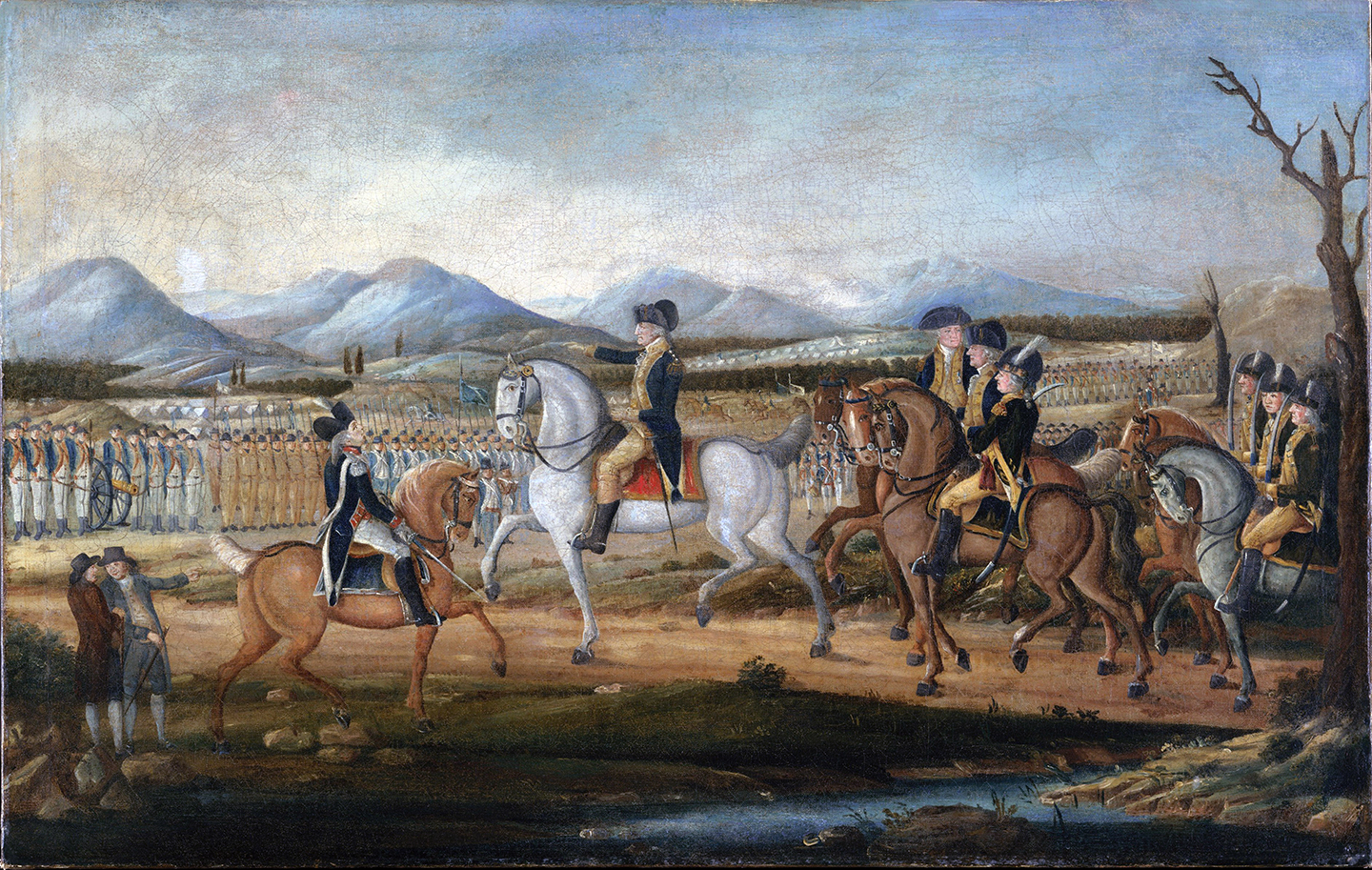
‘Washington Reviewing the Western Army at Fort Cumberland, Maryland’, c. 1795, attributed to Frederick Kemmelmeyer. 63.201.2, the Metropolitan Museum of Art.
Through a generous donation by Dwight Sipprelle, the Newport Historical Society has recently acquired two early 19th century manuscript collections relating to the Whiskey Rebellion and the Insurrection Act. Encompassing a combined one hundred and twelve documents, these newly accessioned materials primarily include troop returns and military correspondence from Rhode Island officials, offering an important insight into how the state mobilized during moments of national crisis in the early years of the country’s formation.
The first collection, dated to the summer of 1794, reflects Rhode Island’s response to President George Washington and Secretary of the Treasury Alexander Hamilton’s call to suppress the Whiskey Rebellion.[1] The rebellion began in 1791 when the federal government, under Hamilton’s financial program, imposed a tax on distilled spirits to help pay off national debt incurred during the American Revolution. Farmers in western Pennsylvania, who depended on converting grain into whiskey for trade and income, viewed the tax as discriminatory and oppressive. Their protests escalated into violent resistance, prompting President Washington to pass the Militia Act of 1792 which allowed the President to temporarily take control of state militias in times of crises. This act was later expanded, providing federal standards for the organization of the Militia, instructing the governors of each state to organize, arm, and equip their militias.[2] In June of 1794, Rhode Island issued its own order to meet the President’s demand, calling up its militia for service. This collection includes an original printed copy of Rhode Island’s edict, detachment orders, letters, and twenty-three troop returns from Newport and neighboring towns.[3] These documents capture how the state’s militia prepared for potential deployment, illustrating both local patriotism and the emerging relationship between state and federal authority. They also offer a compelling glimpse into how communities like Newport participated in the federal government’s early assertion of power.

Letter to Samuel Bridgeham, Rhode Island’s Adjutant General, dated 28 December 1807. 2018.018.047, Gift of Dwight Sipprelle.
The second part of this acquisition contains documents detailing Rhode Island’s response to President Thomas Jefferson’s call for troops under the Insurrection Act.[4] In 1807, amid rising tensions with Great Britain over maritime interference and trade restrictions during the Napoleonic Wars (1803-1815), Congress authorized Jefferson to mobilize one hundred thousand militia from the states in preparation for possible conflict.[5] At the time, Samuel Bridgham served as Rhode Island’s Adjutant General. His retained copies of troop returns and official correspondence form the majority of this archive. This collection includes approximately ninety letters and documents that trace the logistical and administrative buildup of state forces. Among the most significant items are a signed receipt from Secretary of War Henry Dearborn acknowledging the returns, and a series of letters illustrating the coordination between state and federal military authorities.[6] Ultimately, these documents offer valuable insight into how Rhode Island prepared for and contributed to national defense efforts during Jefferson’s administration.
Overall, these two collections demonstrate the complexity of early American defense and Rhode Island’s active role in national preparedness. The documents, a valuable addition to the NHS’ holdings, showcase two moments that tested the balance between local action and federal power; the state’s participation in enforcing federal authority under Washington during the Whisky Rebellion, and safeguarding national sovereignty under Jefferson’s Insurrection Act.
By Sydney Dufresne, Salve Regina University ’26
[1] Newport Historical Society, 2025.018, Box 1, Ms. 141, Newport, RI.
[2] United States Congress, Militia Act of 1792, May 8, 1792, in George Washington’s Mount Vernon, https://www.mountvernon.org/education/primary-source-collections/primary-source-collections/article/militia-act-of-1792.
[3] Raab Collection, LLC, “Responding to President Washington’s and Alexander Hamilton’s Call to the Nation During the Whiskey Rebellion: The Returns of Men and Arms for the State of Rhode Island, June 1794–July 1794,” The Raab Collection, https://www.raabcollection.com/american-history-autographs/washington-hamilton-militia?srsltid=AfmBOoqlWnYzg3iKDB4xYoED_ZSQy9WOaNoAR7uWR9o1M70_uUPE9Ahh
[4] Newport Historical Society, 2025.018, Box 2, Ms. 142, Newport, RI.
[5] Thomas Jefferson, “Sixth Annual Message to Congress,” December 2, 1806. In The Writings of Thomas Jefferson, ed. Paul Leicester Ford, Vol. 8 (New York: G.P. Putnam’s Sons, 1897), 89–97.
[6] Raab Collection, LLC, “Document Signed, Thomas Jefferson, Insurrection Act” (Dec. 16, 1807), The States Respond to President Thomas Jefferson’s Call for Troops under the Insurrection Act archive, https://www.raabcollection.com/presidential-autographs/jefferson-insurrection-act?srsltid=AfmBOornAayoJodyob_Q5Sdp6tfkwL1AyBxC9soGc1sFB5q4zXuDpwxX