

This is a guest blog post by Erika Herman, a recent graduate of New York University, where she earned a master’s degree in museum studies. Erika is a 2025 Buchanan Burnham Fellow.
Prior to the telephone, the best way to send along a holiday greeting or birthday wish to distant loved ones was with a greeting card. Professor Barry Shank posits that “between 1840-1960, greeting cards became significant objects used in the cultural display of emotional eloquence and social connection in the United States.”[1] People use greeting cards to thank, to congratulate, to mourn, to reminisce, to brag, or to catch up. The greeting card format offers a way to quickly communicate with others rather than crafting a longer letter with full updates.[2] While the materials and look of greeting cards may have changed over time—the large, delicate handmade cards of the mid-1800s, the illustrated postcards of the early 1900s, the mass-produced cards found in stores today—sentiments towards them have largely remained the same. Many of us probably have a collection of cards stored in a drawer or a shoebox or perhaps pinned to a corkboard or hung on the fridge for display. These cards may hold memories of those who gave them, include a sweet or funny message, or feature a particularly beautiful illustration compelling us to save them. Those cards might eventually make their way from private collections to museums, like the greeting cards in the Newport Historical Society’s collection.

Christmas card from Maud Howe Elliot, FIC.2025.461, Newport Historical Society collection.
The Newport Historical Society’s Collection of Holiday and Greeting Cards, 1840-1991 is made up of 562 greeting cards encompassing many holidays—New Years, Valentine’s Day, Easter, Thanksgiving, Christmas, and birthdays. Within are many different types of greeting cards including mass produced, handmade cards, postcards, calling cards, and advertisements. The collection has no one origin and was instead added to over the years by various donors. The two main donors to the collection are Emily B. Warren (1875-1965) and Lloyd A. Robson (1893- 1967). Emily B. Warren was the daughter of Emily Forbes Chase Warren and Gouverneur Kemble Warren. Lloyd A. Robson was an artist and Newport historian. The cards were sent and received by a number of notable people including Theodore Francis Green, Oliver Wendell Holms, Maud Howe Elliot, Gwendolen Armstrong, William and Anne Vanderbilt, Thomas Dunn, Harriet Ellery, Edith Ballinger Price, and John A. Roebling. These cards offer a fascinating glimpse into the history of the greeting card industry and into historical everyday life. S.C. Marble sent a valentine to Mrs. L. F. Barker, her “early friend and companion of many happy hours,” with a lock of hair attached as a token of friendship.[3] Painter Edmund Quincy (1903-1997) wrote a Christmas card to Emily B. Warren sometime during World War II, detailing his recent exhibition in New York City and his hesitancy to organize a show in Newport the coming summer as he does not know “how much they are planning for in war-time.”[4]

George C. Whitney, valentine, FIC.2025.330, Newport Historical Society collection.

George C. Whitney’s maker mark , FIC.2025.330, Newport Historical Society collection.
The history of greeting cards has roots in Antiquity, but it is in the fifteenth century that we really see the beginnings of the modern greeting card.[5] Master woodcutters began with producing prints for Christmas and New Years and by the sixteenth century paper valentines were being created.[6] Between the 1500s-early 1800s, greeting cards were regularly exchanged, but their popularity soared after the introduction of penny postage in England in the 1840s.[7] Delicate handmade valentines made of lace paper were the first type of card to flourish with the postal changes, but Christmas cards were not far behind.[8] The first commercial Christmas card was created by John Callcott Horsley in 1843 for Sir Henry Cole in England.[9] Soon both valentines and Christmas cards became popular in the United States as well. Lace paper and other decorative elements were imported from England for American valentine makers like Esther Howland to craft delicate cards and publisher Louis Prang became known as “the father of the American Christmas card.”[10] By the 1860s, greeting cards were being produced at a commercial scale.[11]
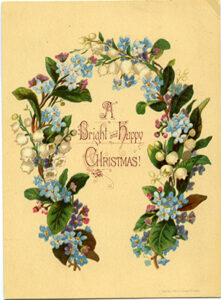
Christmas card from Mary Guendaline Byrd Caldwell, published by L.Prang & Co., Boston, 1880, FIC.2025.410, Newport Historical Society collection.
Throughout early greeting card production, cards were being printed at home and abroad, and many publishers had locations in the United States and across Europe (mainly Germany). In 1895 there was a decline in greeting card production in the United States and England as European printers could produce cheaper products, with almost all greeting cards being printed in Germany by the early 1900s.[12] At the turn of the century, postcards were one of the most popular forms of greeting cards since they were cheaper and easier for short communications.[13] With the start of World War I, the card printing business came back to the United States and during the Interwar years the practice of exchanging cards for seasonal and everyday occasions flourished.[14] During World War II the greeting card industry remained important as families aimed to keep in touch with their loved ones overseas.[15] In the early 1980s, about six billion cards were sent annually in the United States.[16]

Front of birthday card for Eleanor, 1886, published by L. Prang & Co., Boston, 1885, FIC.2025.785, Newport Historical Society collection.
The Newport Historical Society’s collection illustrates many of these historical trends. Twenty-four of the valentines are handmade with lace paper and adorned with collage elements, ribbon, and paints. At least three of these were crafted by George C. Whitney (1842-1915), Esther Howland’s artistic successor. Whitney joined his older brother in the handmade valentine business in 1863 and they worked together at the Whitney Valentine Company until 1869.[17] Whitney continued in the business after his brother left and in 1888 he bought out ten other American valentine companies, including Esther Howland’s.[18] His early valentines were made of imported materials—such as colorful paper and lace—and had scalloped edges, swags and flowers.[19] On the back was stamped Whitney’s maker mark: a red W. Christmas cards make up the majority of the collection, including many of Louis Prang’s (1824-1909). Prang was a lithographer and publisher born in Prussia who moved to Boston in 1850.[20] In 1874, he introduced the Christmas card to an American audience and the cards were a huge success.[21] Prang continued printing Christmas cards until the early 1890s when cheaper German postcards began to flood the American market.[22]

Postcard for Thanksgiving (an American holiday), published by Raphael Tuck & Sons (London), printed in Saxony, 1910, FIC.2025.392, Newport Historical Society collection.
Matching the historical trend, most of the collection’s cards of the late 1890s-1910s were printed outside the United States—Bavaria being the most common location. Some publishers include E. Sborgi in Florence, Raphael Tuck & Sons in London, and Meissner & Buch in Leipzig. Postcards from this time appear in the folders for each holiday—New Years, Valentine’s Day, Easter, Thanksgiving, Christmas and Birthdays. Miss Anne R. Almy received many of these postcards from her friends and family. After the mid-1910s, “Printed in USA” starts appearing on the back of more cards, and more publishers established their base in the United States (The Norcross Greeting Card Company, Sandford Card Co., Henri Fayette, Donay of New York, Buzza Company, and Hallmark).

Back of New Years card addressed to Emily Warren that shows glue & paper residue, FIC.2025.259, Newport Historical Society collection.
In his book, A Token of My Affection: Greeting Cards and American Business Culture, Barry Shank asks, “What can possibly be the historical value of these mass-produced cheap pieces of paper, ink, and glittering decoration? What can these cards possibly mean?”[23] The NHS’s greeting card collection can be used to examine many different histories—the history of technology and communication, the history of art, the history of commercialism, local Newport history, and the social networks of those represented by the collection. While some of these networks are easy to decipher, with full names and dates provided on the card, others are more obscure (such as Eleanor with no last name who received cards from her family and friends in the late 1800s). Many of the cards also show evidence of their creation and use. Some were made from paper with watermarks—showing who made the paper—and others have post office stamps indicating a journey through the postage system.[24] Many of the greeting cards, mainly of Emily Warren’s collection, show evidence of being pasted into scrapbooks for safekeeping and display. These cards meant something to those who originally saved them. Today they can help illuminate stories of historical everyday life that often go unnoticed, like Kit Wright’s love for her pet cow George, the use of these cards as decor, and Emily’s love of collecting.[25] There are still so many stories to tell and mysteries to puzzle over in this collection of greeting cards for those who go looking.
[1] Barry Shank, A Token of My Affection: Greeting Cards and American Business Culture (New York: Columbia University Press, 2004), 7.
[2] One example in the collection: A Christmas postcard to Miss Anne Almy thanking her for a gift and stating that the sender will respond soon to her letter, 1913, FIC.2025.708, Newport Historical Society collection, https://collections.newporthistory.org/Detail/objects/34313.
[3] Green valentine with lock of hair from S.C. Marble to Mrs. L.F. Barker, FIC.2025.370, Newport Historical Society collection, https://collections.newporthistory.org/Detail/objects/33799.
[4] Christmas card from Edmund Quincy to Emily Warren, FIC.2025.456, Newport Historical Society collection, https://collections.newporthistory.org/Detail/objects/33928.
[5] The Editors of Encyclopaedia Britannica, “Greeting Card,” Encyclopedia Britannica, March 15, 2024, https://www.britannica.com/topic/greeting-card.
[6] Britannica, “Greeting Card.”
[7] Britannica, “Greeting Card.”
[8] Britannica, “Greeting Card.”
[9] Britannica, “Greeting Card.”
[10] Britannica, “Greeting Card.” For a brief introduction to Ester Howland: “History Bytes: Valentines,” Newport Historical Society, February 7, 2012, https://newporthistory.org/history-bytes-valentines/.
[11] Britannica, “Greeting Card.”
[12] Britannica, “Greeting Card.”
[13] “Greetings from the Smithsonian: A Postcard History,” Smithsonian Institution Archives, accessed August 4, 2025, https://siarchives.si.edu/history/featured-topics/postcard/postcard-history.
[14] Britannica, “Greeting Card.”
[15] Britannica, “Greeting Card.”
[16] John T. Cacioppo and Barbara L. Anderson, “Greeting Cards as Data on Social Processes,” Basic and Applied Psychology 2, no. 2 (1981), 115, https://doi.org/10.1207/s15324834basp0202_3.
[17] “Valentines,” Museum of Worcester, accessed August 4, 2025, https://worcesterhistorical.com/digital-exhibits/valentines/.
[18] Museum of Worcester, “Valentines.”
[19] Museum of Worcester, “Valentines.”
[20] Marybeth Kavanagh, “Louis Prang, Father of the American Christmas Card,” The New York Historical, From the Stacks [Blog], December 19, 2012, https://www.nyhistory.org/blogs/prang.
[21] Kavanagh, “Louis Prang.”
[22] Kavanagh, “Louis Prang.”
[23] Shank, A Token of My Affection, 13.
[24] Letter to Mr. Thomas Dunn written in 1844 on paper with a watermark for J. Whatman Turkey Mill 1841, FIC.2025.332, Newport Historical Society collection, https://collections.newporthistory.org/Detail/objects/33673.
[25] Christmas card from Kit Wright featuring photograph of George the cow, 1983, FIC.2025.732, Newport Historical Society collection, https://collections.newporthistory.org/Detail/objects/34370, and greeting card mounted on cardboard to hang from wall, FIC.2025.520, Newport Historical Society collection, https://collections.newporthistory.org/Detail/objects/34095.