

This is a guest blog post by Grace Hennessy, a recent graduate of Wellesley College where she earned a B.A. in Art History and Middle Eastern Studies. Grace is a 2026 Buchanan Burnham Fellow.
In 2026, many (if not most) of us can consider ourselves amateur photographers. We capture moments from our daily lives with ease—using our phone cameras to quickly snap pictures of the people, places, and things we don’t want to forget. But during the 1920s, immortalizing a moment through the medium of photography was a far more intentional practice—even for the amateur.
Joseph Nicéphore Niépce discovered the basic principles of image capture in the early 1820s, but it wasn’t until Louis Daguerre invented the daguerreotype in 1839 that photographic technology hit the public market.[1] [2] Initially, photography was primarily a hobby for the wealthy. Photo processing was time-consuming, required capital investment in equipment, and a knowledge of chemistry. But by the turn of the century, the development of hand-held cameras like the Kodak Brownie and the emergence of commercial processing laboratories made photography increasingly affordable for and accessible to a wider range of people.[3] The newfound ease that came with using a camera also ushered in new attitudes toward photography. People became increasingly interested in the authenticity of casual “snapshots” and their ability to give permanence to ways of seeing the world.[4] It is within the context of these changes that we can consider Henry Osborne Havemeyer’s work as an amateur photographer.

Photo taken by Henry O. Havemeyer at Bailey’s Beach during the August 1922 season. Men and women wearing swim attire sit on the sand and talk with one another. 66.14.14, Newport Historical Society.
Henry O. Havemeyer (1876-1965) was a New York-based sugar magnate who, during his many summers in Newport, began to explore the vernacular and casual capacity of photography. Between 1894 and 1935, Havemeyer photographed everything from scenic landscapes to staged portraits, photos of residences, and wide shots of social events. The diversity of the content reflects Havemeyer’s interest in capturing both the refined and regular moments of everyday life. Though all of these photos help shape our understanding of Newport at the turn of the century, it is the candid snapshots that Havemeyer took of his friends, family, and neighbors on Bailey’s Beach that tell us the most about the lived experiences of Newport’s summer elite. Specifically, these images offer insight into the ways that members of high society engaged with concepts of modernity amid the rapid socio-economic and political change of the post-war era.
Newport & the 1920s
The end of WWI marked a period of change for Newport and its summer colony. The ratification of the 19th Amendment, the rise of the sexual liberation movement, prohibition, the proliferation of the automobile, the rise of the middle class, Federal alien restriction legislation of 1921, and pushes for the democratization of public space created a new landscape for Newport’s summer residents.[5] Havemeyer’s candid photographs from Bailey’s Beach during the 1921 and 1922 seasons visualize the impacts of these changes on wealthy Newporters at play.
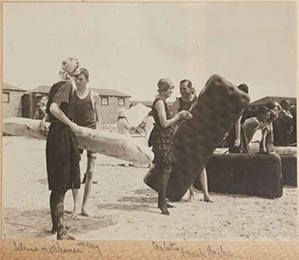
Photo taken by Henry O. Havemeyer at Bailey’s Beach during the August 1921 season. Pictured left to right: Sylvia Hillhouse, Henry Havemeyer Jr., Carlotta Havemeyer, and Frank Roche. The group prepares for a mattress race. 66.14.14, Newport Historical Society.
First and foremost, Havemeyer’s photos capture the ways in which summer residents were engaging with the social and sexual liberation movements of the 1920s. In almost all the scenes from Bailey’s Beach, men and women are shown mingling together. In some images, like those from August 1922, members of both genders sit comfortably with each other on the sand. Wearing swim garments and towels, they talk and laugh casually without pretense or reservation. In other snapshots from the same season, we see women and men dressed in more formal attire who engage with one another at a polite physical distance. These people are often pictured seated on chairs rather than on the sand—evoking a sense of restraint and a concern with proper etiquette. In this way, Havemeyer’s lens reveals the tensions that existed between the increasingly liberal standards of propriety between genders and the conservative attitudes that had historically governed the actions and moral standing of Newport’s elite.
Havemeyer’s photographs also illuminate the ways in which Newport women expressed their newfound social mobility during the 1920s. Armed with the rights afforded to them by the 19th Amendment and the momentum of the sexual liberation movement, women no longer had to exist as extensions of their male counterparts. They could move through society with greater autonomy and self-determination. The fashions of Havemeyer’s female subjects—which emphasize utility over modesty—are reflective of these ideals. In a photo from the August 1921 season, we see Sylvia Hillhouse and Havemeyer’s daughter Carlotta standing next to Frank Roche and Havemeyer’s son Henry as they prepare to participate in a mattress race on the beach. Sylvia and Carlotta wear short-sleeved swim dresses that fall just above the knee, tights that cover their legs, and scarves that protect their hair from the elements. They have dipped their toes into the less restrictive fashions of the period while retaining the sense of modesty that was befitting of their station. Furthermore, their presence at the starting line of the race indicates that physical proximity to the rough and tumble action of a historically male activity had become more socially acceptable.

Photo taken by Henry O. Havemeyer in August 1922 showing the cars parked outside of Bailey’s Beach. 66.14.16, Newport Historical Society.
Havemeyer’s panoramic shots help us understand the degree to which automobiles had proliferated in Newport. In one of his photos from August 1922, we see the parking lot and street outside of Bailey’s Beach both filled with cars. The popularity of automobiles is indicated not only by the number in the photo but also by the presence of the wide, paved road upon which they sit. This tells us that the use of automobiles was so great that public infrastructure needed to be altered to accommodate the number of vehicles on the roads.[6] This image also reflects the way that the members of the summer colony embraced the modernizing wave of mechanization that was sweeping the nation.[7]
Havemeyer’s photographs are a critical component of Newport’s historical record. They show us how the members of Newport’s summer colony engaged with the ideological and technological modernization of the 1920s. The photos are equally crucial examples of the period’s changing attitudes toward photography—reflecting the desire for the authentic and permanent capture of fleeting moments. Thanks to the digitization efforts of the Newport Historical Society, Havemeyer’s photo albums are now available for public access online here. The increased visibility of these photos will be crucial for helping people see Newport through Havemeyer’s lens.
Bibliography
“Niépce and the Invention of Photography.” Nicéphore Niépce’s House Museum. Accessed June 20, 2026. https://bicentennial-of-photography.org/niepce-invention-photography/.
Ritzenthaler, Mary Lynn, and Diane Vogt-O’Connor. Photographs: Archival Care and Management. Society of American Archivists, 2006.
“Smarthistory – Photography in the Early 20th Century, an Introduction.” Smarthistory. Accessed June 20, 2026. https://smarthistory.org/an-introduction-to-photography-in-the-early-20th-century/.
Warburton, Eileen. In Living Memory: A Chronicle of Newport, Rhode Island, 1888-1988. Newport Savings and Loan Association/Island Trust Company, 1988.
“The Roaring Twenties.” Gilder Lehrman Institute of American History. Accessed June 21, 2026. https://www.gilderlehrman.org/history-resources/essays/roaring-twenties.
[1]“Niépce and the Invention of Photography,” Nicéphore Niépce’s House Museum, accessed June 20, 2026, https://bicentennial-of-photography.org/niepce-invention-photography/.
[2] https://smarthistory.org/early-photography-niepce-talbot-and-muybridge/
[3] Mary Lynn Ritzenthaler and Diane Vogt-O’Connor, Photographs: Archival Care and Management (Society of American Archivists, 2006), 14.
[4] “Smarthistory – Photography in the Early 20th Century, an Introduction,” Smarthistory, accessed June 20, 2026, https://smarthistory.org/an-introduction-to-photography-in-the-early-20th-century/.
[5] Eileen Warburton, In Living Memory: A Chronicle of Newport, Rhode Island, 1888-1988 (Newport Savings and Loan Association/Island Trust Company, 1988), 63-67.
[6] Warburton, In Living Memory, 63.
[7] “The Roaring Twenties,” Gilder Lehrman Institute of American History, accessed June 21, 2026, https://www.gilderlehrman.org/history-resources/essays/roaring-twenties.