

This is a guest blog post by Eliza Anderson, a recent graduate of Fordham University, where she earned a B.A. in History and French and Francophone Studies. Eliza is a 2025 Buchanan Burnham Fellow.

A photograph of the Union Congregational Church, located on Division Street, before 1955. Union Congregational evolved from the FAUS and was the first Black church founded in Newport. P1829, Collection of the Newport Historical Society.
In the wake of the American Revolution, the rapidly expanding community of free African Americans in the Northeast was faced with the challenge of adjusting to a life where ‘freedom’ did not always mean prosperity. In Newport, where the percentage of free Black residents had reached 65% of the total Black population by the time of the 1790 census, freeholders were confronted with a city still deeply enmeshed with the business of slavery .[1] Barred from full participation in traditional institutions like the church, banks, insurance, and abolition societies dominated by white Northerners, free Black Newporters were forced to build their own institutions of community support. In the last two decades of the eighteenth century, free Black populations in Northern cities began to organize mutual aid societies to help alleviate the social and economic burden left on newly liberated households. These voluntary associations were formed to provide a financial safety net for sick or otherwise vulnerable community members, but they also helped to create a body of community leaders who could speak on issues relevant to free Black residents in their cities.
The first free Black mutual aid society, the Free African Union Society (FAUS), was established sometime between 1780 and 1787 by a group of free Black Newporters. Officers and committee members of this group included Anthony Taylor, Caesar Lyndon, Salmar Nubia, Lymas Keith, and eventually Newport Gardner, men who constituted an early Black elite in Newport because of their property ownership and ability to pay society dues. The FAUS tasked themselves with organizing burials, helping to cover medical costs for members and their families, recording births and deaths, setting proper rules of conduct, and communicating with free Black leaders in other cities. An offshoot of the FAUS, the African Benevolent Society, would establish a school for Black children in 1808. In 1824, members of the FAUS established the Colored Union Congregational Church, the first African heritage church in Newport.[3]
In addition to being the first of its kind, the FAUS is unique in that it left behind rare first-hand accounts of early Black institution-making in four volumes of meeting minutes covering the years 1787 to 1824.[4] Following the group from its initial founding as the African Union Society, to its renaming in 1802 as the African Humane Society, and the founding of the separate African Benevolent Society in 1807, these ledgers provide invaluable insight into the concerns and aspirations of the free Black community in post-Revolution Newport. Importantly, the Newport records also provide a glimpse into the networks of communication emerging across the northeast. Copied into the African Union Society volume are over forty-five letters sent and received from abolitionists, ministers, and free Black communities in Providence, Boston, and Philadelphia. Looking closely at this correspondence reveals how the FAUS served as model and supporter for the founding of other free Black institutions across the northeast.
—

A letter sent from Boston to Newport on June 1, 1787, discussing a plan to communicate with other free Black communities on the topic of Sierra Leone. Vol. 1674B, p. 14, Collection of the Newport Historical Society.
The earliest recorded communication between the FAUS and other free Black communities appears in letters received from Boston in 1787. In Boston, early Black institutions included the African Lodge, a fraternal order founded by Prince Hall which received an official charter from England in 1784.[5] Though the Boston African Society was not founded until 1796, Prince Hall’s African Lodge played an important role in the 1780s and ‘90s as a foundational free Black institution with which other free communities could communicate.[6] In June of 1787, Samuel Stevens, a free Black Bostonian who was likely associated with the African Lodge, wrote to the African Union Society in Newport on the subject of immigrating to Sierra Leone. Well before the advent of the American Colonization Society in 1816, plans to establish a colony of formerly enslaved Africans in the West African country of Sierra Leone were being orchestrated by the British and advertised to free Black communities across the northeast. The project was financed by the Sierra Leone Company, a group of wealthy English investors who shared abolitionist tendencies but were ultimately united in their desire to make a profit from the emigration of formerly enslaved Africans.[7] American abolitionists and ministers like William Thornton and Samuel Hopkins proved to be successful salesmen for the project among some free Black communities in the northeast in the 1780s and ‘90s. As the FAUS began to communicate with other free Black organizations in different cities, the question of African emigration emerged as an issue at the center of a burgeoning network of elite Black Americans.
Within the 1787 letter, Stevens tells the members at Newport that “we hartily [sic] agree with you in sending surcular [sic] Letters to our free Blacks in all the States, as it will Strengthen our Number.”[8] This reference to a directive of the FAUS to initiate communication between different cities on the topic of Sierra Leone highlights how FAUS members served as early leaders not only of their community in Newport, but of the larger community of free Africans Americans across the north. In kickstarting region-wide communication, the FAUS built the foundation for the circulation of information, warnings, recommendations, donations, collaborations, and prayers between Black communities that would enable the formation of activist movements in the nineteenth-century.

A letter sent from Providence to Newport on August 5, 1789. Bristol Yamma and James McKenzie sign-off as “your afflicted brethren.” Vol.1674B, p. 25, Collection of the Newport Historical Society.
In nearby Providence, free Black community members looked to Newport for guidance and collaboration in founding an auxiliary chapter of the Free African Union Society. On July 27, 1789, FAUS president Anthony Taylor sent a letter “to all the Affricans in Providence” expressing “our sincere desire” for them to “join us in this Society so that we all may promote one common good.”[9] In August, Bristol Yamma[10] and James McKenzie of Providence wrote to Newport to ask, “if you would, by the first Opportunity, send up your Regulations and every Particular of your Proposals, as we are only waiting to see them for the satisfaction of all our brethren in Providence.”[11] On September 22, free Blacks in Providence under the leadership of Cato Coggeshall – a former Newport resident – wrote to their “dear Brethren” in Newport to report that “we have established ourselves in the name of the Union Society.”[12] Following the bylaws and officer hierarchies already established in Newport, free Black men in Providence became organized around the mission of community support. Importantly, the Providence organization was hopeful that “if any of our Members that belongs to Providence should by chance be in want of any sum of money and that our Treasury should not be sufficiently stored so as to supply his or our Necessary want…shall have Resource to the Treasury in Newport.”[13] In their next letter, the members in Newport were happy to accept the request for a shared treasury. The relationship between the societies in Newport and Providence was thus a kind of partnership in which free Blacks in both cities recognized the benefits of mutual support. Though the records do not indicate that Providence members ever exercised this benefit, the FAUS’s willingness to offer their mutual aid to outside groups demonstrates how they envisioned other free Black populations as an extension of their own community.
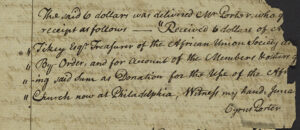
A receipt for the donation of six dollars to Cyrus Porter and the African Church. Vol.1674B, p. 186, Collection of the Newport Historical Society.
The FAUS also corresponded with free Black organizations in Philadelphia. The Philadelphia Free African Society (FAS) was formed in 1787 by Richard Allen and Absalom Jones, both free Black men who would go on to lead Philadelphia congregations at St. Thomas’s African Episcopal Church (f. 1791) and Bethel Methodist Church (f. 1794).[14] The FAS, like its counterpart in Newport, was non-denominational, though the members’ main goal moving into the 1790s was the founding of the city’s first African Church under the guidance of Absalom Jones.[15] In 1793, after hosting Deacon Cyrus Porter of the newly formed African Church, the FAUS sent six dollars to aid in the building of a meeting house in Philadelphia. The meeting minutes note that “the said members belonging to said Church in Philadelphia are desirous of Correspondence & future friendship to subsist between the said Members, Africans & others in Philadelphia.”[16] Those six dollars, equal to about $200 today, represented a significant portion of the society’s treasury, and thus a special meeting had to be called the next month at which each member was expected to pay one shilling to help cover the cost of the donation.[17] The FAUS’s willingness to part with such a sum demonstrates what the members in Newport saw as their responsibility toward free Black communities in other cities: to aid in the founding of further Black institutions.

Lithograph of Bethel African Methodist Church (f. 1794), Philadelphia, July 1829. Bethel was the site of the first convention of the American Society of Free Persons of Color in 1830, led by its pastor, Richard Allen. 7500.F, Library Company of Philadelphia.
The letters referenced here represent only a small sampling of the early correspondence between the FAUS and other eighteenth-century free Black societies, but they all speak to the key role that Newport community leaders played in the formation of a region-wide network of free Black organizing. When Black leaders from different cities met in Philadelphia under the title of the American Society of Free Persons of Color in 1830, they were building on the legacy of communication and collaboration begun by mutual aid societies like the FAUS.[18] Addressing this convention of Black delegates, Richard Allen spoke of the “conclusions” of the Society: “that our forlorn and deplorable situation earnestly and loudly demand of us to devise and pursue all legal means for the speedy elevation of ourselves and brethren to the scale and standing of men.”[19] That leaders like Allen could speak to a united platform of action — one that would form the basis of the Colored Conventions of the nineteenth-century — meant that the early correspondence between free Black societies had blossomed into a network of Black communities capable of launching a movement for civil rights.
[1] 1790 U.S. Census of Rhode Island
[2] While scholars typically point to 1780 as the year of founding, the available records do not provide substantial evidence to definitively date the establishment of the FAUS. The earliest FAUS record at NHS is a letter from Anthony Taylor of the “Union Society” to William Thornton, dated January 24, 1787 (Vol.1674B, p. 11-12). There is a much-cited published transcription of the FAUS proceedings by William H. Robinson, who notes that the earliest surviving records are from 1787, but cites two scholars who he believed had worked with records proving the 1780 founding date. Neither of the two sources (from 1886 and 1932) contain footnotes. Curiously, the 1932 reference to the founding date in Charles A. Battle’s Negroes on the Island of Rhode Island contains quotes from what Battle claims is the society’s 1780 constitution, formed at a subsequent meeting at the Fourth Baptist Meeting House. Upon further inspection, these “quotes” have been pulled word-for-word from a letter to free Black societies written by a convention of white delegates from the Abolition Societies in the United States in 1796, and from the FAUS meeting minutes of November 10, 1796. While the language in the 1787 letter to Thornton indicates that the society had already been operating in Newport for some time, it is not clear exactly how many years had passed since the founding of the FAUS. For the published transcription, see William H. Robinson, The Proceedings of the Free African Union Society and the African Benevolent Society: Newport, Rhode Island 1780-1824 (The Urban League of Rhode Island, 1976), 16.
[3] Joey La Neve DeFrancesco, “Abolition and Anti-Abolition in Newport, 1835-1866,” Newport History: Journal of the Newport Historical Society, Winter/Spring 2020, https://newporthistory.org/abolition-and-anti-abolition-in-newport-1835-1866/.
[4] Free African Union Society and African Benevolent Society Records, 1787-1824, MS.095, Collection of the Newport Historical Society, https://collections.newporthistory.org/Detail/collections/142. The NHS has four volumes of related records: Minutes of the African Benevolent Society, 1807-1824 (Vol.1674A); The Book of Records of the African Union Society, 1787-1796 (Vol.1764B); Minutes of the African Union Society & African Humane Society, 1803-1810 (Vol.1674C); Minutes of the African Humane Society, 1812-1823 (Vol.1674E).
[5] https://princehall.org/african-lodge-459/.
[6] “Laws of the African Society, Instituted at Boston, Anno Domini 1796,” Massachusetts Historical Society, Collections Online, http://www.masshist.org/database/573.
[7] Christy Clark-Pujara, “Chapter Five: Building a Free Community,” in Dark Work: The Business of Slavery in Rhode Island (NYU Press, 2016),116.
[8] The Book of Records of the African Union Society, Vol.1674B, p. 14, Collection of the Newport Historical Society, https://collections.newporthistory.org/Detail/objects/26659. Transcribed in Robinson, letter 3.
[9] The Book of Records of the African Union Society, Vol.1674B, p. 17, Collection of the Newport Historical Society, https://collections.newporthistory.org/Detail/objects/26662. Transcribed in Robinson, letter 9.
[10] Bristol Yamma was born in Africa, bought his freedom, was educated at Princeton, and trained under Ezra Stiles, pastor of the Second Congregational Church of Newport. Alongside John Quamine, Stiles had intended for Yamma to pursue mission work on the African continent, though the plans never materialized. For more on Yamma, see George E. Brooks, “The Providence African Society’s Sierra Leone Emigration Scheme, 1794-1795: Prologue to the African Colonization Movement,” The International Journal of African Historical Studies 7, no. 2 (1974): 185-186, https://doi.org/10.2307/217128. For more on early Black history at Princeton, see https://slavery.princeton.edu/stories/african-americans-on-campus-1746-1876.
[11] The Book of Records of the African Union Society, Vol.1674B, p. 24, Collection of the Newport Historical Society, https://collections.newporthistory.org/Detail/objects/26669. Transcribed in Robinson, letter 9.
[12] The Book of Records of the African Union Society, Vol.1674B, p. 26, Collection of the Newport Historical Society, https://collections.newporthistory.org/Detail/objects/26671. Transcribed in Robinson, letter 15. Cherry Fletcher Bamberg, “The Cato Coggeshalls: An African-American Family of Newport and Providence, Rhode Island,” The American Genealogist 85, no. 2 (2011): 141–51.
[13] Ibid.
[14] Julie Winch, Philadelphia’s Black Elite: Activism, Accommodation, and the Struggle for Autonomy, 1787-1848 (Temple University Press, 1988), 11-12, http://archive.org/details/philadelphiasbla0000winc.
[15]Records of the Philadelphia Free African Society and the First African Church were published in 1862, with an introduction and notes from William Douglass, the church historian. The volume includes a letter written by the AUS in Newport, and an exchange with free Blacks in Boston under the leadership of Prince Hall. William Douglass, Annals of the First African Church, in the United States of America, Now Styled the African Episcopal Church of St. Thomas, Philadelphia. (King & Baird, printers, 1862), http://archive.org/details/annalsoffirstafr00doug.
[16] The Book of Records of the African Union Society, Vol.1674B, p.185, Collection of the Newport Historical Society, https://collections.newporthistory.org/Detail/objects/26814. Transcribed in Robinson, p. 91.
[17] The Book of Records of the African Union Society, Vol.1674B, p. 193, Collection of the Newport Historical Society, https://collections.newporthistory.org/Detail/objects/26818.
[18] For more on the Colored Conventions of the 19th century, check out this great digital resource: https://coloredconventions.org/.
[19] American Society of Free Persons of Colour (1830 : Philadelphia, PA), “Constitution of the American Society of Free Persons of Colour, for improving their condition in the United States; for purchasing lands; and for the establishment of a settlement in upper Canada, also, The Proceedings of the Convention with their Address to Free Persons of Colour in the United States,” Colored Conventions Project Digital Records, 2025, https://omeka.coloredconventions.org/items/show/70.