

This is a guest blog post by Kaitlin Osucha, a recent graduate of Washington College in Chestertown, MD, where she earned a Bachelor of Arts in History and a minor in Museum, Field, & Community Education. Kaitlin is a 2026 Buchanan Burnham Fellow.
During the late 19th century, as new and faster modes of transportation emerged, people traveled more for leisure. It was not long before the practice of purchasing and sending postcards was popularized in resort towns like Newport. Created around the 1870s, postcards were a relatively affordable item that visitors could purchase to send messages or hold onto as keepsakes to document trips. Often, people would display their newly purchased postcards in their homes, to evoke fond memories of their travels.[1] In Newport, this practice can be seen throughout the vast array of postcards preserved in the Newport Historical Society’s Collection, which includes an estimated 5,000 postcards dating from the years of the late 19th-century-20th century.
The Newport Historical Society’s collection features postcards of natural landscapes, including stretches of the Cliff Walk and Gilded Age mansions, images of houses of worship such as this postcard of Touro Synagogue,[2] as well as Newport’s streetscapes and architecture. These visuals reflect both the reasons visitors were drawn to visit Newport, and the memories they would wish to retain of their travels.

Color postcard of the exterior of Touro Synagogue, undated. 2009.3.12, Newport Historical Society.
In 1894, the postcards we are familiar with today featuring images of idyllic beach landscapes and architectural wonders were popularized.[3] However, it was not until the end of the 19th century that private companies began to produce postcards with images and space for handwritten text on one side and the address on the other.[4] In 1902, the divided postcard emerged, allowing for images to be on one side and the written note and address to be on the other side.[5] This new format allowed more space for correspondence.[6]
Postcards quickly became a popular format of communication as they allowed the sender to write a quick message instead of a longer letter, an easy way to stay in touch while traveling.[7] This postcard featuring Chetwode, the residence of John Jacob Astor, illustrates this style of communication. The sender of the postcard, postmarked April 28, 1949, scribbled a quick message on the back: “Having a good time be home soon.”[8]
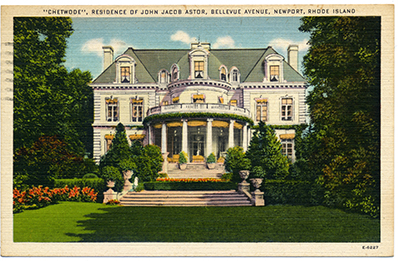
A linen-type postcard of Chetwode, the residence of John Jacob Astor. 2010.10.25, Newport Historical Society.
Postcards manufactured between 1915-1930 fall into a style category known as “the White Border Period.”[9] This style change occurred at the beginning of World War One, when Americans stopped importing printed materials from German manufacturers.[10] This change drastically altered the quality of the postcards, due to inferior printing technology in the United States compared to Europe.[11] To save money on ink, a white border was added around the printed image.[12] This style is exemplified in this postcard, which shows the entrance to The Breakers. Postmarked September 12, 1915, the correspondent included the brief message, “Am sending you some cards showing places I saw today.”[13]
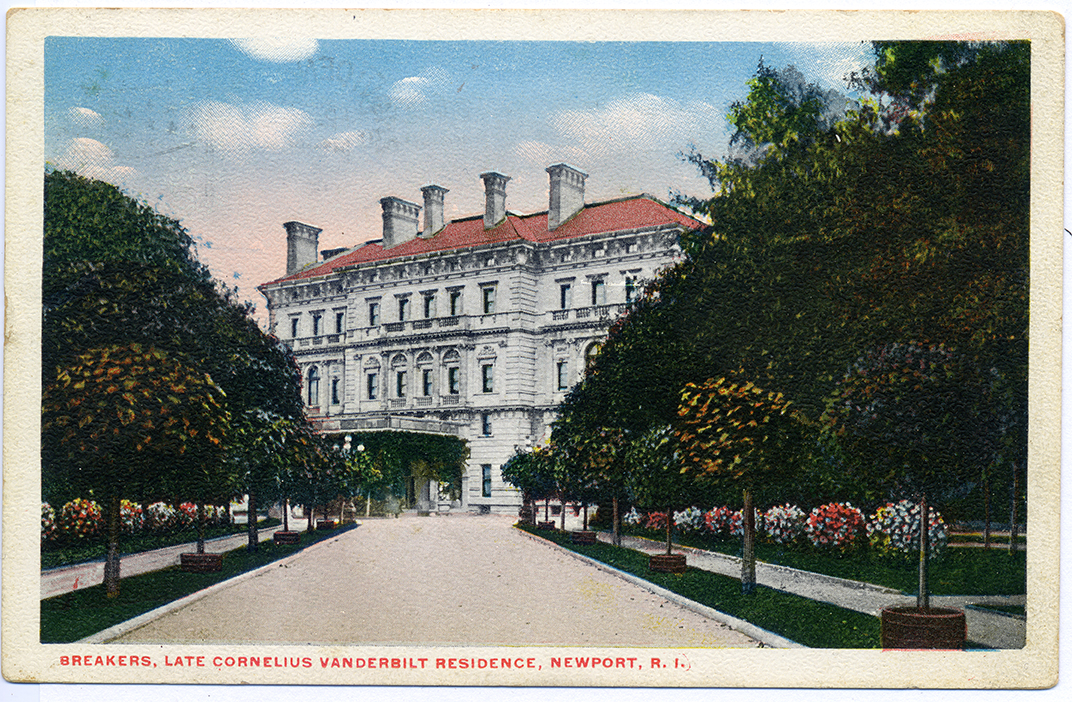
A postcard depicting the entrance to The Breakers. 2012.1.1, Newport Historical Society.
American printers fought to stay current with emerging printing trends, including a style popular from 1930-1945 known as the “Linen Period.”[14] This innovative printing technique allowed the material of the postcard to resemble linen.[15] A notable company that used this printing style was Curt Teich & Co.[16] In 1931, the company printed their first linen postcard, generating a faster production process than previous postcard styles and using brighter and more vibrant colors.[17] This postcard, printed after 1930, captures the view of the Cliff Walk from Belmont Beach; the colors of the scene are bright and clear, resulting in a picturesque memento.[18]

Linen-type color postcard featuring the residences along Cliff Walk from the view of Belmont Beach. 2009.3.50, Newport Historical Society.
These postcards capture a moment in time when Newport was emerging as a major center for tourism and travel. They reflect the city’s appeal to visitors by showcasing both its natural landscapes and its architectural wonders. Today, these artifacts offer us a glimpse into the experiences and perspectives of people drawn to Newport during its height as a resort town.
[1] “The Postcard Boom of the Early 1900s,” Cleveland Public Library, January 3, 2026, https://cpl.org/the-postcard-boom-of-the-early-1900s/.
[2] Newport Historical Society, 2009.3.12
[3] The Postal Museum, “Postcards.”
[4] The Postal Museum, “Postcards.”
[5] The Postal Museum, “Postcards.”
[6] The Postal Museum, “Postcards.”
[7] The Postal Museum, “Postcards,” Accessed June 5, 2026, https://www.postalmuseum.org/collections/highlights/postcards/.
[8] Newport Historical Society, 2010.10.25.
[9] Smithsonian Institution Archives, “Greetings from the Smithsonian A Postcard History,” Accessed June 5, 2026, https://siarchives.si.edu/history/featured-topics/postcard/postcard-history.
[10] Smithsonian Institution Archives, “Greetings from the Smithsonian A Postcard History.”
[11] Smithsonian Institution Archives, “Greetings from the Smithsonian A Postcard History.”
[12] Smithsonian Institution Archives, “Greetings from the Smithsonian A Postcard History.”
[13] Newport Historical Society, 2012.1.1.
[14] Smithsonian Institution Archives, “Greetings from the Smithsonian A Postcard History.”
[15] Smithsonian Institution Archives, “Greetings from the Smithsonian A Postcard History.”
[16] Smithsonian Institution Archives, “Greetings from the Smithsonian A Postcard History.”
[17] Smithsonian Institution Archives, “Greetings from the Smithsonian A Postcard History.”
[18] Newport Historical Society, 2009.3.50.